A fallen tree on a roof, a split limb over a vehicle, or an uprooted trunk after heavy rain can feel overwhelming. The first priority is keeping people clear of danger. Call (423) 819-6618 for a prompt response discussion; if there is a life-safety or electrical emergency, call 911 or the utility provider first.
What counts as a tree emergency?
An emergency is generally a tree condition with immediate potential to harm people, block essential access, damage a structure, or create an electrical hazard. Common calls include trees on homes or cars, limbs through a roof, trees across driveways, cracked trunks, hanging branches after wind, and trees uprooted by saturated ground.
Not every storm-damaged branch requires middle-of-the-night removal. If the tree is stable, clear of structures, and not creating a public or electrical hazard, the work may be scheduled as a priority but non-emergency visit. We will help you describe the condition so the next step is sensible.
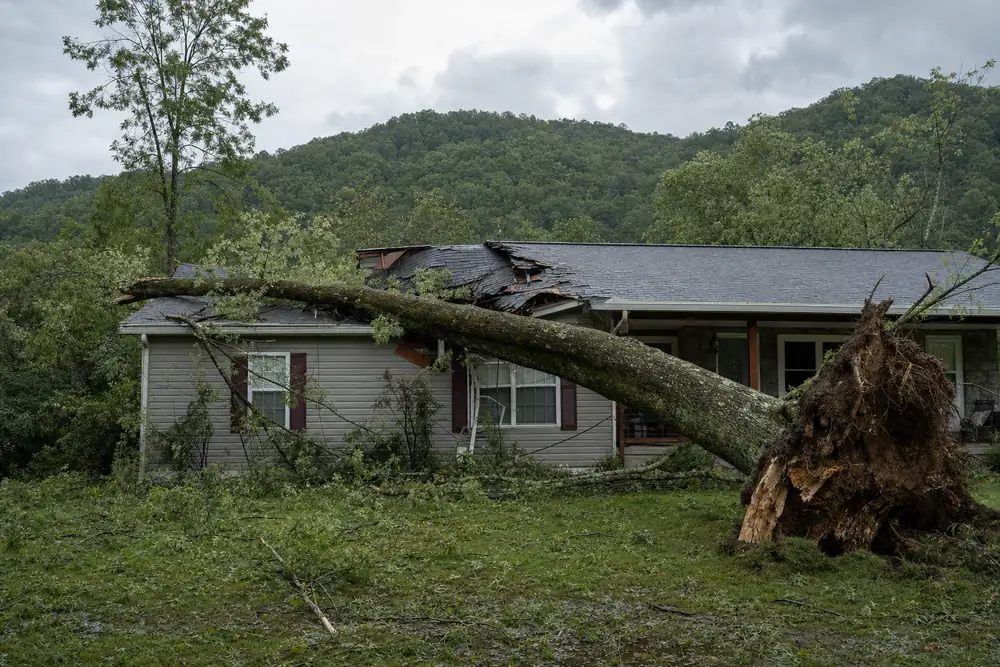
Safety first after a storm
Stay out from under hanging limbs and keep children, pets, and neighbors away from the area. Do not climb on a roof, use a chainsaw near a damaged tree, or try to pull a trunk off a building with a vehicle. Storm-damaged trees can shift without warning.
If a tree or limb has contacted a power line, assume the area is energized. Keep everyone clear, call the electric utility, and call 911 if there is immediate danger. Do not touch the tree, fence, vehicle, puddle, or ground nearby.
Our emergency response process
1. Call and describe the hazard
Tell us where the tree is, what it has hit or is threatening, whether anyone is injured, and whether utilities are involved. Photos can help us understand the situation, but never take a photo from an unsafe position.
2. Secure the immediate hazard
Once life safety and utility concerns are addressed, a tree crew assesses how to stabilize the work zone. The plan may involve removing a hanging limb, sectional dismantling, moving debris, or making a damaged area safer until full work can proceed.
3. Protect the property where possible
Crews use controlled cuts and rigging appropriate to the site. A damaged roof, vehicle, fence, or landscape may limit access, so the safest method takes priority over speed alone.
4. Remove or clear the tree material
The team cuts, lowers, moves, and stages debris based on the job scope and site conditions. Larger or complex failures can require additional equipment or a follow-up visit once conditions are safe.
5. Document and plan the next step
Take your own photos for insurance records before cleanup when it is safe to do so. Ask the crew what has been completed, what remains, and whether stump grinding, roof repair, or an assessment of nearby trees should be scheduled.
Fallen trees on homes, cars, and power lines
Trees on structures call for deliberate coordination. Do not start removing limbs from a roof or vehicle; taking weight off in the wrong order can make damage worse. Contact your insurer to understand its claim process, but do not delay emergency stabilization while waiting for an adjuster if the condition is unsafe.
For a tree across a public road, call 911 or the appropriate local authority. For utility-line contact, the power company must handle the electrical danger before tree work begins. We can help with the tree once the area has been cleared for safe access.
Storm damage or a tree on a structure? Call now. Call (423) 819-6618 and we will walk through the tree, the access, and the next practical step. Licensed & insured crews serving Johnson City and the Tri-Cities.
Call (423) 819-6618Storm damage tree removal in the Tri-Cities
The region’s wind, rain, ice, and hilly terrain can expose weak unions, root problems, and deadwood quickly. We serve Johnson City, Kingsport, Bristol, Elizabethton, Jonesborough, Gray, and Boones Creek for urgent tree service when availability allows.
We do not make promises about a specific arrival time or outcome before seeing the conditions. Weather, road closures, power-line hazards, and regional demand can affect response. What we can offer is clear communication and a practical plan for the tree problem in front of you.
Call for emergency tree help
Call (423) 819-6618 now for 24/7 emergency tree service in Johnson City, TN. For non-urgent removals, see tree removal; for routine pruning that can reduce deadwood risk, see tree trimming.